I have heard variously that I “write well”, that I “don’t write English like a proper native”, use outmoded & archaic vocabulary, and even that my comptes-rendus de chantier read like Proust. (By that, my employers’ client presumably meant they were indigestible.)
My most recent clients have been Paris-based Koreans, writing in French and in English. They at least have expressed gratitude for broadening their knowledge of our languages.
Mediterranean friends seem most to enjoy my humour, so here goes :
Political dissent
Given that BREXIT has undermined the legitimate foundations of professional practice in Europe for holders of British qualifications (whatever their nationality) a wee protest seemed to be in order.
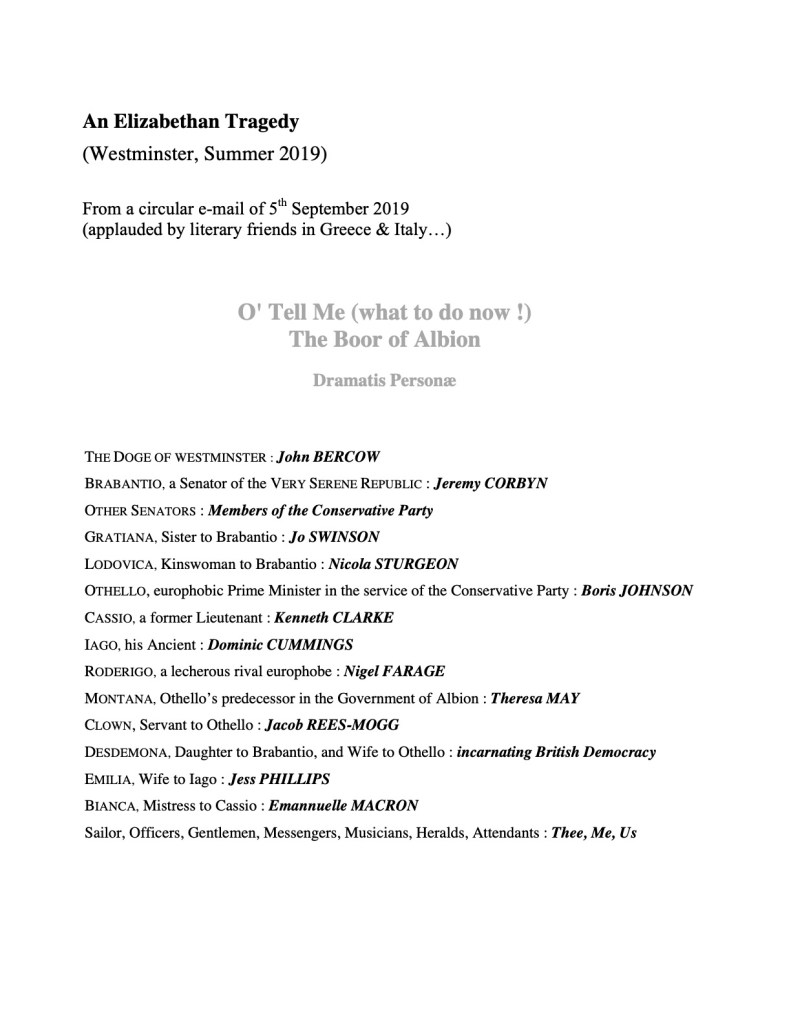
Published texts
Alma Mater Stabat Mater, scultura e politica del novecento in Freiburg, in Anna DOLFI, Stabat Mater, Immagini e sequenze nel moderno, Firenze University Press, 2018
Studio Alchymia, in Building Design, 2 October 1981
Memphis, in Building Design, 2 October 1981
Unpublished texts
Sacré lieu, Sardaigne, an essay in French on Sardinia’s sacred places of congregation
Giovanni MUZIO, research paper on the Italian architect presented for RIBA Part II exemption
Transcription of interview of Amyas CONNELL, conducted with Robin CRANE (toward Part I exemption)
Transcription of interview of Dennis SHARPE, conducted with Robin CRANE (toward Part I exemption)
Translations
Fabio REINHART,
Armelle BLARY, catalogue Transports
Presently a significant part of my time is increasingly spent proof-reading, revising or translating the texts of academics, artists and other conceptually demanding individuals.
My academic spouse and her colleagues have used me often enough to firm up the expression of their sometimes tentative English, even attracting praise from third party peer reviewers. Hence one’s own success is often embedded in that of others.
Likewise, I have always maintained that good design is about editing, winnowing out the irrelevant and the redundant, strengthening the clarity of what needs to be expressed, which the design itself, or the text itself, will reveal to the author, who should remain essentially, and humbly, an inspired agent of coherence.
The Ancients called this the Muse, that artists and writers should heed.
Doing so requires acute critical faculties, all the more difficult to engage where one’s own work is concerned. Concerning the critical editing of texts, I consider that skill to be analogous to those one brings to bear in the elaboration of architectural projects.
Related or parent pages :
Professional Teaching
 opus incertum